 Employer Assessment Tests: Practice Questions by Sector
Employer assessment tests are the screening tests companies and organizations give applicants before an interview. Employers use them to compare large numbers of candidates fairly and to check the skills a role depends on, such as reasoning, attention to detail, or mechanical knowledge. Some also include an employer personality test, which looks at how you tend to work instead of what you know.
That's why employer tests for hiring look so different from one sector to the next. A bank might focus on numerical reasoning, a utility company on mechanical aptitude, and a retailer on how you handle customer situations.
This page covers 7 major sectors that use pre-employment tests: Retail and Corporate, Finance and Banking, Public Safety and Law Enforcement, Government and Federal, Aviation, Skilled Trades and Apprenticeships, and Utility and Energy. Each section lists the employers and organizations that use these tests and gives you 3 sample questions. Work through them as a quick career employer practice test.
Try the sample questions to get a feel for the tests employers use in each prospective sector. Each section also links to full practice tests on jobtestprep.com, so you can keep practicing and learn more about your employer's test.


Why Do Employers Use Pre-Employment Tests
A resume shows where you've worked, and an interview shows how you talk about it. Neither shows how you'd handle the daily demands of the job, and that's the gap employer tests for hiring are designed to fill.
When hundreds of people apply for the same role, a test gives every candidate the same questions, the same time limit, and the same scoring. That makes comparing applicants fairer, and it helps hiring teams decide who to interview first. Tests also check skills tied to the role itself, such as numerical reasoning for finance jobs, mechanical aptitude for utility jobs, or situational judgment for customer-facing roles.
Not every employer test comes from the same place, and knowing which kind you're facing helps you prepare. Pre-employment tests generally fall into 2 categories:
- Tests built around the employer. Some employers use assessments tailored to their own roles, values, and leadership principles. The Amazon Work Style Assessment is an example: it's built around Amazon's Leadership Principles, so the content is specific to that company.
- Tests created by an outside assessment company. Other employers hand testing to a third party that builds and runs the test, then shares the results with the employer. The same test can appear in the hiring process of many different employers. Ramsay and SHL are examples, and the P&G Interactive Assessment is provided by Aon. You can read more about these providers on our assessment companies page.
The difference matters for your prep. A company-specific test calls for employer-specific practice, while a provider's test is easier to handle once you're familiar with that provider's question formats.
Because every candidate takes the same test, preparation can make the difference. Knowing the question types, practicing under time limits, and walking in without surprises can help you perform at your best and stand out from other applicants. JobTestPrep has helped thousands of candidates to do exactly that, with online practice tests and study materials for employer assessments. The sections below cover 7 major sectors, with sample questions you can try first.
Employer Assessment Tests by Sector
The tests employers use depend heavily on the industry. Each of the 7 sectors below names the employers that use these tests, links to full practice for each employer, and includes 3 sample questions so you can see what the format looks like. Start with the sector you're applying in, or work through all 7 for a broader career employer practice test. If a specific sector or company interests you, follow its links for extra practice, including free samples on many of the pages.

Retail and Corporate
Large retailers and corporations hire for very different roles, so the assessment you get depends on the job. A store team lead, a maintenance technician, a financial analyst, and a software developer can each face a different test, even at the same company. Amazon's own jobs site notes that assessment types and timing can vary by team.
Three formats show up most often in this sector. Situational judgment tests present realistic workplace scenarios and ask how you'd respond. Work style questionnaires describe how you prefer to work and check whether that fits the employer's culture. For technical and analytical roles, reasoning games and technical tests measure how you solve problems. Many of these tests are built around the employer's own values, so knowing what the company stands for is part of your prep.
Here are the employers in this sector with practice available:
- Amazon. Amazon's online assessments commonly include a work simulation, which is a scenario-based situational judgment test, and a work style assessment built around the company's Leadership Principles. Practice is available for the Hiring and Work Simulation, Work Style, AWS, and Area Manager assessments, plus the Financial Analyst, Maintenance Technician, and software development engineer assessments.
- Walmart. The test depends on the role. Maintenance roles take a technical maintenance assessment. Team lead, supervisor, academy trainer, and department manager roles use the Teaming Employment Assessment, which combines workplace scenarios with questions about your work style. Management roles such as assistant manager, area manager, and coach trainee use the Manager Assessment. Our guides advise keeping your answers consistent across each of these tests.
- P&G. P&G's hiring process commonly includes 2 online assessments. The PEAK Performance Assessment mixes situational judgment scenarios with questions about your work style. The Interactive Assessment is a set of online reasoning games, known as the Switch, Grid, and Digit challenges, that takes about 30 minutes according to P&G, and the games you see can depend on the role you apply for. Aon provides the Interactive Assessment, one of the outside assessment companies we cover.
- Honeywell. Practice tests are available for the assessments used in Honeywell's hiring process.
- Epic Systems. Practice is available for Epic's technical assessments, including the one for Technical Problem Solver roles.
Looking for a different employer? Browse our retail and corporate employer test prep for the full list.
This question comes from Walmart's Teaming Employment Assessment, used for roles such as team lead and supervisor. It shows a line chart of 5 departments' performance against goal and asks you to compare them across 2 quarters. It checks whether you can read performance data quickly and accurately, a daily task for anyone who tracks a team's results. Start with the chart title and the question, then look only at the quarters it asks about and ignore the rest. Find the departments at the top in Quarters 1 and 2. When 2 lines cross, compare them quarter by quarter to see which comes out ahead overall.

Which department had the highest productivity during quarters 1 and 2?
This question is from the technical track for Amazon maintenance technicians. It shows a motor control circuit and asks what happens when a button is pressed and then released. It checks whether you can read an electrical diagram and predict how equipment will behave, the same skill you'd use to troubleshoot a control panel on the job. Trace the circuit from the button and follow the current to each component it affects. Pay attention to what stays connected after you let go of the button, and check whether each component in the answers is part of the circuit that button controls.

What will happen if the forward button is pressed and released after a while?
This is a situational judgment question, the format used in P&G's hiring assessments. It describes a realistic workplace scenario and asks what you'd do. This one measures ambition, proactivity, and innovative thinking: do you act on a chance to grow, or stay in your comfort zone? Before you read the options, ask yourself which trait the scenario is testing. The strongest answer shows initiative and accountability together, so look for the option that does both, and be wary of answers that are passive or only express frustration.
You feel that your work has become repetitive and is no longer challenging you. However, you have also become quite comfortable with the way things are running. You have a review meeting with your manager scheduled in two days.
What would you do in this situation?

Finance and Banking
Banks, lenders, and trading firms hire for roles built around numbers, risk, and customers, so their assessments lean on reasoning skills and judgment. Many also check how your values and work style fit the company, since the work is regulated and trust matters.
Four formats show up most often in this sector. Numerical reasoning tests ask you to find answers in tables, charts, and graphs under a time limit. Verbal reasoning tests ask you to draw conclusions from written passages. Situational judgment tests and personality or values questionnaires check how you'd act at work and whether that fits the employer. Some trading firms add speed-based mental arithmetic and probability questions, where timing matters as much as accuracy.
Here are the employers in this sector with practice available:
- Barclays. The Barclays online assessment includes a cognitive ability section covering numerical, verbal, and inductive reasoning, a personality assessment, and a values and mindset assessment. Keeping Barclays' stated values in mind helps with the last one.
- Capital One. Capital One uses online assessments in its second hiring stage. They're split into 4 exams: situational judgment, verbal reasoning, numerical reasoning, and a coding assessment.
- RBC. Most graduate roles start with an online assessment similar to a situational strengths test, and some roles add verbal and numerical reasoning tests. Our RBC practice also covers personality assessments and Aon's smartPredict games.
- Optiver. Candidates report speed-focused online assessments for this trading firm, with sections such as mental arithmetic, numerical reasoning, and probability. Practicing under a time limit is a big part of preparing.
Looking for a different employer? Browse our finance and banking employer test prep for the full list.


Public Safety and Law Enforcement
Police departments, fire departments, dispatch centers, and federal agencies hire through some of the most structured screening processes of any sector. A written or computer-based test is usually the first step, and many agencies use the scores to screen and rank candidates before physical, psychological, and background stages.
Each department or agency chooses its own exam, so the test you take depends on where you apply. Three formats are the most common. Written aptitude tests measure reading, writing, math, logic, memory, and mechanical reasoning. Situational judgment and video-based tests show you workplace scenarios and ask how you'd respond. Job simulations, such as the ones used for 911 dispatchers, test skills like multitasking and data entry under time pressure.
Here are the main groups of employers in this sector with practice available:
- Police and law enforcement. Entry-level police exams are usually multiple-choice written tests. PELLET B, the POST Entry Level Law Enforcement Test Battery, is widely used and covers reading, writing, and logical ability in 105 questions. Practice is also available for the CPCA, NYPD, LAPD, and CJBAT exams, plus the separate police psychological exam.
- Firefighting. Departments choose their own firefighter written exam, and most cover reading, math, mechanical reasoning, and memory. The FireTEAM exam can include video-based human relations, mechanical aptitude, math, and reading tests. The FACT has 110 multiple-choice questions split into a general aptitude section and a personal characteristics section. The FST measures cognitive abilities and non-cognitive traits and doesn't require any firefighting knowledge. We also offer practice for the CPS, FCTC, and NFSI exams.
- 911 dispatchers. CritiCall is a computer-based test made up of modules, and the hiring agency chooses which ones to use. Common modules include data entry, call summarization, and memory recall, and you don't need prior dispatcher knowledge. Practice is also available for the POST dispatcher exam in California and the Ontario Provincial Police CritiCall test.
- FBI. According to the FBI, the Phase 1 exam is a proctored, computerized test of about 3 hours made up of 5 assessments. Phase 2 includes a writing assessment and a structured interview with a panel of 3 special agents. See our FBI sample questions for more.
- Homeland security. The Secret Service uses the Special Agent Entrance Exam (SAEE) and the Uniformed Division Entrance Exam (UDEE), both competency-based assessments. The SAEE measures skills such as written communication, critical thinking, and attention to detail, and the UDEE takes about 3½ hours. TSA officer candidates take the TSA CBT, which comes in 2 versions depending on the test location: a traditional test of about 2.5 hours with X-ray image and English sections, and a shorter assessment battery without them. Practice is also available for the GardaWorld and EDPT assessments, and you can browse our homeland security test prep.
Looking for a specific department or agency? Browse our police exam, firefighter test, and 911 dispatcher test prep for the full list.

Government and Federal
Government employers hire through standardized processes, and the exam you take usually depends on the job or title you apply for. That applies to the postal service, federal agencies, state and city civil service systems, and public service employers in Canada.
Four formats are the most common in this sector. Job-specific exams test the skills a role depends on, such as the postal exams. Online competency assessments measure general abilities like decision making and attention to detail. Work simulations put you in a supervisor's seat and ask how you'd handle realistic situations. Situational judgment and behavioral questionnaires check how you'd act at work. Many of these tests are computer-based, and some can be taken at home while others are proctored at a testing center.
Here are the main employers and exams in this sector with practice available:
- USPS. The postal exam you take depends on the job. Exam 955 is used for maintenance positions such as mechanics and electricians, and it's a separate test from the others. Exams 474 to 477 cover carrier, mail handler, mail processor, and customer service clerk jobs, and they share the same core sections, with some adding a fourth. We also offer practice for the 710 clerical exam.
- USA Hire. The U.S. Office of Personnel Management delivers these online, unproctored assessments for federal jobs, and you're invited to take one after you submit your application. The standard assessments for non-supervisory positions measure general competencies such as decision making, reading, attention to detail, integrity, and flexibility, and some use online simulations and role plays.
- Supervisory Test Battery. Civil service agencies such as the New Jersey Civil Service Commission use this computer-based work simulation for supervisory titles. You take the role of a supervisor in a fictitious organization and handle situations and in-basket items, such as memos, that a supervisor would receive.
- Canada Revenue Agency (CRA). The CRA uses Korn Ferry assessments that can cover cognitive abilities (numerical reasoning, verbal reasoning, and checking), behavioral competencies, and traits. It also uses situational judgment tests, and some roles require accounting or auditing tests.
Looking for a specific agency? Browse our USPS exam, USA Hire, and Supervisory Test Battery prep for the full list.

Aviation
Airlines and air navigation providers hire for safety-critical roles, so their assessments focus on specific abilities such as memory, spatial awareness, multitasking, and sound judgment under pressure. Many of these tests are computer-based, and the format changes a lot between roles.
Four formats show up most often in this sector. Cognitive test batteries measure skills like memory, reasoning, attention, and mental math. Multitasking and simulation tasks test how you handle several demands at once. Mechanical aptitude tests check how well you understand tools and machines. Scenario-based assessments ask how you'd serve passengers and handle problems on the job.
Here are the main employers in this sector with practice available:
- Air traffic control. The FAA's Air Traffic Skills Assessment (ATSA) is a computer-based, entry-level test battery made up of multiple subtests that measure the skills and attributes air traffic controllers need. The FEAST, designed by EUROCONTROL for European air navigation providers and ATC academies, starts with cognitive tests and an English test, and later modules include radar simulations and a personality questionnaire. At NAV CANADA, the first step is a timed online assessment of about 30 minutes that evaluates memory, working speed, spatial visualization, reasoning, attention, information processing, and simple math.
- Delta Air Lines. Flight attendant candidates take the Virtual Job Tryout, an online assessment with 6 interactive, scenario-based sections. Aircraft maintenance technician candidates take the BMAR assessment. Practice for both is on our Delta Air Lines page.
- Pilots. American Airlines includes an online Pilot Skills Test in its pilot application. Candidates report a computerized battery covering skills such as memory recall, logic, pattern recognition, and mental arithmetic.
Looking for a specific airline or air traffic service? Browse our ATSA, FEAST, and NAV CANADA prep for the full list.
This is a logical reasoning question in the style of the FAA's Air Traffic Skills Assessment (ATSA). It gives you a set of scheduling rules and asks which arrangement follows all of them. It checks whether you can keep several conditions in mind at once and apply them accurately, which matters in air traffic control, where decisions have to follow strict rules. Don't try to build the schedule from scratch. Test each answer option against the rules instead, and eliminate any option that breaks even one. Start with the rules that are the most specific, since they rule out options fastest.
For a two-day career event at a local high-school class, exactly six out of eight parents with different occupations - florist, gardener, historian, inventor, jeweler, locksmith, mailman, and optician - are chosen to introduce their occupations to the class. On each day exactly three different parents will speak to the class in three different time slots - morning, mid-day and afternoon, subject to the following conditions:
- The florist can only speak on day 2.
- The gardener and the locksmith cannot speak in mid-day.
- If the gardener speaks on day 1, then the optician and the jeweler speak on day 2.
- The inventor and the mailman will not speak on the same day.
- If both the inventor and the locksmith are speaking, then the inventor speaks sometime before the locksmith.
Which one of the following could be a complete and accurate schedule of the two-day careers event (in order of appearance)?
This is a spatial reasoning question in the style of the Delta BMAR assessment, which Delta uses for aircraft maintenance technician candidates. It shows a set of separate shapes and asks how they'd look once assembled. It checks whether you can picture parts fitting together in your head, a skill technicians use when reading diagrams and putting components together. Pick out the distinctive features of the original pieces, such as the largest shape and how many of each shape there are. Then compare each option against the original piece by piece before you choose.
Choose the image that shows how the objects will appear if assembled:

This is an inductive reasoning question in the style of American Airlines' Pilot Skills Test. You study example grids to work out a rule, then choose the 2 grids that follow it. Pilot aptitude tests commonly measure pattern recognition and logical thinking, skills that help pilots spot what's important in a lot of information. Look at the examples first and ask what stays the same and what changes, within each grid and from grid to grid. Then test your rule on each option, one row at a time. Remember that 2 of the grids follow the rule, so keep checking until you've found both.

Choose the two grids that follow the rule.


Skilled Trades and Apprenticeships
Union and employer-sponsored apprenticeship programs train people from the ground up, so their entrance exams focus on the skills you'll need to learn the trade, not on what you already know about it. Most programs use the exam to decide who moves on to an interview, and many fill a limited number of spots.
Four skill areas show up most often in trade aptitude tests. Math and algebra questions check how comfortably you work with numbers and formulas. Reading comprehension questions check whether you can follow written instructions and technical material. Mechanical comprehension questions look at how you understand tools, machines, and forces. Spatial reasoning questions ask you to picture how shapes fold, fit, or rotate.
Here are the main trades with practice available:
- IBEW (electricians). Electrician apprenticeship programs use an aptitude test that assesses algebraic functions and reading comprehension. It's a standardized test taken at the local training center, and applicants who pass move on to an interview with the Joint Apprenticeship Training Committee.
- Elevator constructors. The Elevator Industry Aptitude Test (EIAT) is used for apprenticeships with the International Union of Elevator Constructors. According to the National Elevator Industry Educational Program, it covers reading comprehension, mechanical comprehension, and basic math in 100 multiple-choice questions. A score of 70% or higher is needed to move on to an interview.
- Plumbers. The Plumbers Union aptitude test most commonly used in the U.S. has 140 questions and a 120-minute time limit. It covers 6 topics: reading, numerical computation, numerical reasoning, folding (spatial reasoning), problem solving, and mechanical comprehension.
- Pipefitters. Local unions in the U.S. and Canada use a pipefitter screening test to choose apprentices. Our preparation covers math, English, mechanical aptitude, and spatial reasoning.
- Other trades. We also offer practice for the sheet metal, millwright, ironworker, and heavy equipment operator apprenticeship exams.
Looking for a different trade? Browse our trade apprenticeship exam prep for the full list.
This is a number series question for practicing the pattern and math skills the IBEW aptitude test relies on. You're given a sequence and asked for the next 2 numbers. It checks how well you spot a rule and apply it accurately, a skill that supports the math electricians use on the job. Compare each pair of neighboring numbers by both their difference and their ratio, and write down what happens at each step. Once you've found the pattern, continue it twice, since the answer needs both numbers.
What would be the next number in the following series?
7 | 14 | 28 | 32 | 64 | 128 | ? | ?
The correct answer is (C).
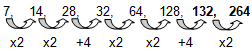
The series repeatedly increases by x2, x2, +4.
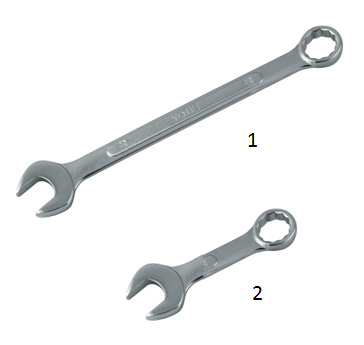
This is a mechanical comprehension question in the style of the Elevator Industry Aptitude Test (EIAT). It shows 2 versions of a tool and asks which one would take more effort to use. It checks whether you understand how simple tools and forces work, which matters for elevator mechanics who install and service equipment. Start by identifying the tool and what it does. Then compare the 2 pictures, find the feature that differs between them, and ask how that feature changes the force you'd need. Read all the answer options before you choose.
Which of the following wrenches would require more effort to operate?
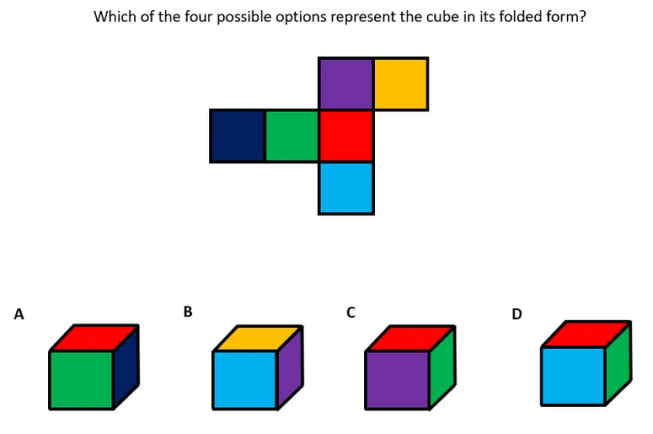
This is a folding question in the style of the plumbers union aptitude test, which includes a spatial reasoning section on folding. You see a cube that has been unfolded into a flat pattern and choose the folded cube that matches it. It checks your ability to visualize 3D shapes, a skill plumbers use when reading plans and drawings. Work out which faces sit opposite each other and which ones touch along an edge. Then use a couple of faces you're sure about to place the rest, and rule out any option that shows faces together in a way the flat pattern doesn't allow.
Folding Sample Question

Utility and Energy
Utility and energy companies hire for safety-critical technical roles, such as plant operators, maintenance technicians, electricians, and system dispatchers. Their tests lean on math, mechanical and electrical understanding, reading, and job-specific technical knowledge, and some roles also include a physical ability test.
Many investor-owned electric utilities use standardized aptitude batteries from the Edison Electric Institute (EEI), while others, such as Southern Company and PG&E, use their own tests. If you're not sure which test your employer uses, our power and utility company test guide lists the exam for each major U.S. utility. These exams can be long. The EEI CAST battery takes about 2 hours, and Southern Company's study guide says its General Plant Operator test lasts about 8 hours with breaks.
Here are the main employers and exams in this sector with practice available:
- EEI tests. EEI doesn't give these tests to applicants directly, so you take them through the utility you apply to. CAST (Construction and Skilled Trades) is used for transmission and distribution, facilities and equipment, and meter reader jobs. It's a battery of 4 tests: Graphic Arithmetic, Mechanical Concepts, Reading for Comprehension, and Mathematical Usage. POSS (Plant Operator) and MASS (Power Plant Maintenance) are separate tests for plant operator and maintenance positions. SO/PD (System Operator/Power Dispatcher) is used for energy control center jobs and includes tests such as Applied Arithmetic and Electrical Concepts Knowledge. We also offer practice for TECH (technician roles) and SASS (support and administrative roles).
- Southern Company. Georgia Power's SKAT Electrician test has 4 sections: electrical knowledge, hand and power tools, rule reading, and tools and precision measurement. The SKAT Meter test, used for meterman positions, has 3 sections covering electrical knowledge, hand and power tools, and rule reading. The General Plant Operator (GPO) test measures knowledge of the electrical, operations, and mechanical tasks a plant operator performs.
- PG&E. According to PG&E, its pre-employment tests are taken online and, depending on the job, may measure general ability, job-specific skills, job knowledge, or work-related attitudes. The prerequisite tests include the Physical Test Battery, the Industrial Skills Test, the Clerical Test Battery, and the Work Orientation Inventory.
- Oil and gas. We also offer practice for the Marathon and ExxonMobil assessments.
Looking for a different utility? Find your employer in our power and utility company test guide or browse our EEI test prep for the full list.
This is a graphic arithmetic question from the EEI CAST battery, which is used for transmission and distribution, facilities and equipment, and meter reader jobs. You study a drawing with labeled measurements and calculate a length that isn't shown directly. It checks whether you can read a plan accurately and do practical arithmetic with it, as crews do when working from site drawings. Before you calculate anything, look at which dimensions are labeled and which are missing. Decide which labeled lengths combine to make the one you're asked for, and whether you need to add or subtract them. Keep an eye on the units.
Use the diagram below to answer the following question.

What is the total length (A) of the Foundation?
Answer:
The correct answer is D.
The simplest way to calculate the length (A) of the Foundation – is to sum the length of the Crown Block, and the two lengths from the edges of the Crown Block to the corresponding edges of the Foundation:

This is an interpreting diagrams question in the style of the EEI TECH test, which is used for technician roles. You get a detailed map or diagram and are asked to count specific items in specific areas. It checks your attention to detail and your ability to read a busy drawing without losing your place, a skill technicians use with maps and schematics. Read the question first to see exactly what you're counting and where. List the areas that qualify before you count anything, then go through them one at a time and keep a running total. Use the grid labels so you don't skip or double-count.
Interpreting Diagrams Sample Question
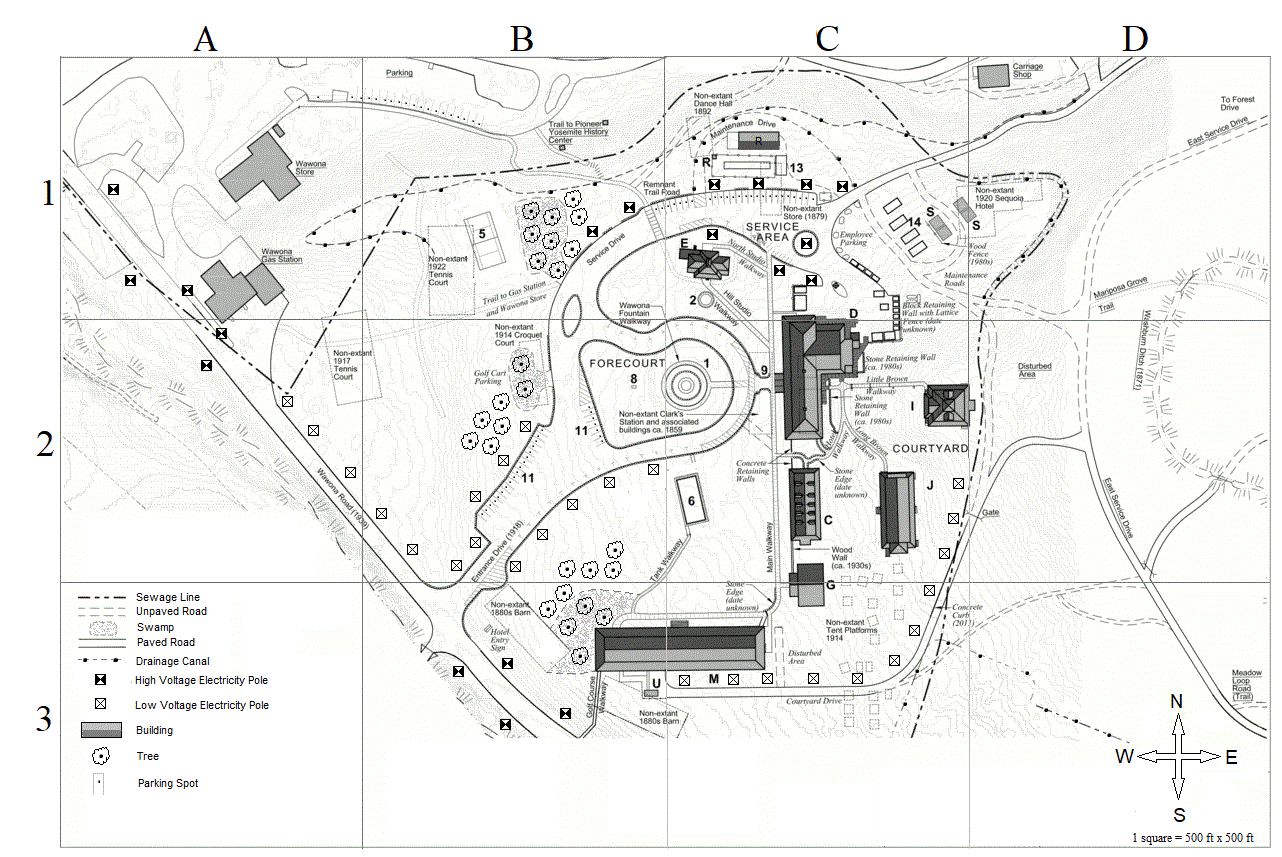
How many high-voltage electricity poles are there in sections through which the drainage canal passes?
The correct answer is C.
To solve this question, it will be best to look for each element separately. First, we will write down the sections in which the sewage line passes (A1, B1, C1, D1, C3, D3). Then, we will count the high-voltage electricity pole in each section and sum the result.
A1 = 3, B1 = 2, C1 = 8, D1 = 0, C3 = 0, D3 = 0.
Total = 3 + 2 + 8 = 13.

This is an analytical thinking question of the kind used to practice for the SOPD system operator test. It gives you a set of facts about where items are placed and asks which combination is possible. It checks whether you can apply several conditions at once and reason through the options, a skill that matters for system operators who manage many constraints at the same time. Start by drawing the rooms and placing the facts that are fixed. Then use the remaining rules to narrow down where the others can go, and test each answer against all of the conditions. The question asks what is possible, so an option only needs to fit in one arrangement that follows every rule.
Five bears – Jinan🐻, Knot🐻, Lee🐻, Mushu🐻, and Nee-Hau🐻 – are kept in three adjacent rooms numbered 1-3 from left to right.
Important Facts:
- There is at least one bear in each room.
- Knot is in a room to the left of Lee's.
- Mushu and Nee-Hau are not kept in the same room.
- Either Mushu or Jinan, but not both, are kept in room 2.
- Nee-Hau is kept in room 3.
Which of the following pairs is a possible combination for two occupants in one of the rooms?
Since N is in room 3 and K must be left of L, K can be in room 1 or 2.
Place J and K in room 1.
Room 2 must contain M (because J is already placed).
L can then be placed to the right of K, creating a valid setup.
Example arrangement: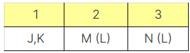
All rules are satisfied, so A is correct.

How to Prepare for Employer Assessment Tests?
Good career employer test prep starts with knowing what you'll face. These 5 steps apply to most employer assessments:
- Find out which test your employer uses. Check the job posting, the recruiter's email, relevant social media forums (like Reddit) or the careers page, since the test often depends on the role as well as the company. If it comes from an outside provider, our assessment companies page explains the major ones.
- Practice the question types. Start with the sample questions above, then move on to full practice for your employer using the links in your sector. For general practice, try our aptitude tests.
- Practice under time limits. Many employer tests leave only seconds per question, so time yourself from the start and learn when to move on.
- Review the explanations. For every question you miss, read why the correct answer works and why yours didn't, then look for patterns in your mistakes.
- Answer work style questions honestly and consistently. Personality questionnaires, including the employer personality assessment test some companies add, don't measure what you know, and contradictory answers can count against you. Our pre-employment personality test page shows what to expect.
Start with the sector above that matches your job, then follow its links to practice the exact test you'll take.
Employer Assessment Tests FAQs
Employer assessment tests are the screening tests companies and organizations give applicants before an interview or a job offer. They measure skills such as reasoning, math, reading, mechanical understanding, or judgment, and some include a personality or work style questionnaire. The exact test depends on the employer, the sector, and the role.
Many employers rank applicants by test score, so knowing the format and managing the clock can set you apart from candidates who walk in unprepared. Free PDFs and AI-generated practice tests may look reliable, but they're often outdated or don't match the real format, and there's no way to verify that they reflect your employer's actual test.
Our PrepPacks™ are built differently. They're modeled on the question types, format, and time limits of the real tests, and our test specialists analyze and solve every question, so you get a full explanation of why each answer works, not just the answer itself. Timed simulations let you practice under the same pressure you'll face on test day, and study guides cover the skills behind each question type. Start with the sample questions on this page, then choose the PrepPack for your test.
The most common types are cognitive and aptitude tests (math, reading, and logic), mechanical and technical tests, situational judgment tests, personality or work style questionnaires, and job simulations. Which ones you face depends on the job. A bank may focus on numerical reasoning, a utility on mechanical and electrical concepts, and an airline on spatial ability and multitasking. For a full explanation, see our guide to pre-employment tests.
An employer personality test is a questionnaire that describes how you tend to work, such as how you handle teamwork, pressure, and change. It usually has no right or wrong answers, and employers use it to see whether your work style fits the role and the company. Some use tests from providers such as Hogan, Caliper, and Predictive Index, while others build their own. You can learn more on our pre-employment personality test page.
Start with the job posting and the email from the recruiter, since they often name the test or the provider. You can also look up your employer in the sector sections above, or in our power and utility company test guide if you're applying to a utility. If you can't find it, ask the recruiter or HR contact directly, because the test can change by role.
No. Some industries share standardized tests, such as the many utilities that use EEI tests or the apprenticeship programs that use a common aptitude test. In other cases the test varies by employer, department, or job. Fire and police departments choose their own exams, and the postal service uses different exams for different jobs. Always confirm the test for your specific application.
Employers use a range of personality and work style assessments, including tests from providers such as Hogan, Caliper, and Predictive Index, as well as questionnaires built by the company itself. These tests usually have no right or wrong answers, since they describe how you tend to work. You can learn more on our pre-employment personality test page.
It depends on the employer. Some allow a retake after a waiting period. For example, PG&E says all of its pre-employment tests allow a retest after a waiting period. Others limit retakes or tie them to a new application, so check the policy before you test, and prepare as if you only have one try.
It depends on how familiar you already are with the question types and how long your test is. We recommend at least 1 to 2 weeks of focused practice, using timed practice tests so you get used to the pace. A steady routine works better than cramming the night before.
No. They're practice questions that show the format and the skills each test measures, but they aren't the real test content, and actual tests can differ by employer, role, and year. Use them to get a feel for the questions, then follow the links in each section for full practice for your employer's test.


