 Hogan Personality Inventory (HPI) Preparation (2026)
Last updated: July 27, 2026 | Trusted by thousands worldwide.
Our HPI PrepPack helps you understand what employers are actually looking for. With targeted practice and realistic examples, you'll learn how to present your strengths effectively and align your responses with what the role demands.
Hogan Personality Inventory (HPI)
Most Popular
1-Month HPI Access
Your PrepPack includes:
- 1 Full HPI-Style Personality Simulation
- 30 Single-Trait Personality Practice Tests
- 3 In-Depth Study Guides


Inside Our HPI PrepPack
Our Hogan Personality Inventory PrepPack helps you understand your personality profile and teaches you how to present your strengths effectively.
- 1 Full HPI-Style Personality Simulation:A realistic simulation that mirrors the structure and style of the actual assessment, so you're familiar with the format going in.
- 30 Single-Trait Personality Practice Tests: Supplementary practice across the Big Five personality traits, helping you build broader insight into how individual responses reflect specific characteristics, skills that transfer directly to how the HPI's own seven scales are assessed.
- 3 In-Depth Study Guides: Learn how the HPI works, what employers look for, and how to approach each question strategically.
Together, these give you realistic practice and a clear understanding of what each part of the HPI is actually measuring.
Prepare For Your Hogan HPI Test
Get all the practice you need with a full-length HPI simulation and targeted practice tests, or explore our full Hogan Bundle if you're facing more than the HPI.
What Is The Hogan Personality Inventory?
The Hogan Personality Inventory (HPI) is a scientifically validated assessment that measures day-to-day personality traits, also known as “bright side” traits.
It's a straightforward assessment featuring 206 short statements. You simply decide if each one is true or false of you.
The test takes about 15 to 20 minutes to complete, with clear, simple language so you focus on how you act, not on over-interpreting questions. What counts is the pattern of your responses across the whole assessment, not any single answer.
The Hogan Personality Inventory is often misunderstood as a test of who you are. In reality, it measures something more specific and more practical: How other people are likely to experience you at work.
It's built on the idea that career success depends less on your intentions or self-image and more on your reputation, your characteristic way of behaving in public, especially under pressure. This is why Hogan distinguishes between identity (how you see yourself) and reputation (how others describe you).
Employers hire, promote, and trust people based on reputation.
The HPI doesn't measure intelligence, technical skill, or experience. It assumes you're already qualified. What it evaluates is how you're likely to show up once you're on the job, as a leader, a colleague, or a contributor.
Understanding this shift from "Who am I?" to "How will I be perceived?" is the key to interpreting the HPI correctly and responding in a way that aligns with your target role.
Our HPI PrepPack is built around practicing exactly this shift.
Get HPI Sample Questions & Practice
Looking for HPI practice questions and answers? Our full HPI preparation toolkit includes complete simulations, solving tips, and expert-designed study guides.
HPI Scales: What The Assessment Measures
When employers review Hogan Personality Inventory results, they don’t see raw answers to 206 statements.
They see a reputation profile built around seven primary personality scales, each reflecting a pattern of behavior others are likely to experience over time in the workplace.

No scale is inherently good or bad. Each can help or hurt depending on the role and how extreme the score is.
The seven HPI scales are:
- Adjustment: How calm and emotionally steady you appear under pressure. High scores suggest stress tolerance, while low scores suggest reactivity. Extremes signal either volatility or resistance to feedback.
- Ambition: Leadership drive, competitiveness, and energy. High scores signal initiative, valuable for leadership and sales roles, while low scores suit support roles. Very high scores can read as pushy or self-promoting.
- Interpersonal Sensitivity: Tact, warmth, and social awareness. High scores signal diplomacy, while low scores suggest bluntness. Too little causes friction, and too much can mean conflict avoidance.
- Inquisitive: Creativity, curiosity, and strategic thinking. High scorers seem imaginative, while low scorers seem practical and execution-focused. Very high scores can suggest weak follow-through.
- Learning Approach: Interest in education and technical learning. High scores suggest intellectual engagement, while low scores suggest learning by doing. Very high scores can mean overemphasis on theory over action.
- Prudence: Organization, dependability, and respect for rules. High scores suggest reliability, while low scores suggest spontaneity. Extremes signal either rigidity or poor follow-through.
- Sociability: How outgoing and socially visible you appear. High scores suggest comfort with attention, while low scores suggest a preference for working independently. This doesn't predict performance on its own.
Together, these seven scales create a picture of how you're likely to be experienced at work - that is, not just what you can do, but how you do it.
How Hogan Scoring Works
Hogan scoring isn't just about high or low scores. It’s about whether your responses are valid, consistent, and aligned with what a specific role requires.
The scoring process happens in two stages: First, your results must be usable. Then, they're interpreted against what the job demands.
1. Hogan Validity Scale: Your Results Must Be Valid
Before your personality results are reviewed, Hogan checks whether your responses can be trusted at all. This is done through the Hogan Validity Scale, a set of embedded statements designed to detect inconsistent, careless, or overly managed answering.
These are not trick questions. They're simple statements most people respond to in predictable ways. Answering outside those patterns flags the assessment as potentially unreliable.
To pass, you must score 10 or higher on the Hogan Validity Scale. If your responses fall below the required threshold, your entire assessment is labeled invalid and never interpreted by the employer, regardless of how strong or relevant your other scores might have been.
If your validity score falls below the required threshold, your entire profile is labeled invalid and never interpreted by the employer, regardless of how strong your other scores were. Leaving too many of the 206 items unanswered has the same effect, so staying focused through the full assessment matters.
2. Hogan Percentiles: Scores Are Compared, Not Judged
Once your results are valid, they're interpreted.
Hogan doesn't give a pass or fail score. Instead, results are reported as percentiles, comparing your responses to a large working-adult norm group. A percentile shows how you rank relative to others, not how good or bad you are.
- Scores at the 65th percentile and above are considered high
- Scores between 36 and 64 are considered average
- Scores 35 and below are considered low
On their own, percentile labels don't determine whether you're a strong candidate. What matters is how your scores compare to the target range for the role.
Every strength carries a potential downside. High Ambition, for example, can read as leadership drive or pushiness, High Prudence as reliability or rigidity, and Low Sociability as focus or disengagement.
That's why employers evaluate your whole profile against a target pattern, rather than judging each trait alone.
3. Hogan Job Families: Fit Depends On The Type Of Role
To interpret those patterns, employers typically group roles into two broad categories (or, job families).

These are:
- Getting Ahead roles (managers, executives, sales leaders): Evaluated primarily on Ambition, Adjustment, and Prudence. Employers want candidates who are driven, energetic, and steady under pressure.
- Getting Along roles (service, administrative, support): Evaluated more on Adjustment, Prudence, and Interpersonal Sensitivity. Employers want reliable team members who read social situations well.
The same score can be an asset in one job family and a liability in another. For example, a highly ambitious profile may stand out in leadership but work against a service role, while a highly rule-focused profile may suit structured positions but feel rigid elsewhere.
At its core, the HPI doesn't measure how impressive your personality is. It measures how well your personality fits the role you're applying for.
How To Pass The HPI
Passing the HPI isn’t about maximizing scores. It’s about matching the behavioral profile required for the role.
That’s why your strategy should vary depending on the type of position you’re targeting.
The tips below serve as general guidelines for approaching Hogan personality questions:
- It's all about how you behave at work: The HPI measures how you behave in a workplace context, so your answers should reflect your professional behavior, not your everyday behavior.
- Focus on the position you're applying for: Since the HPI evaluates how well your personality aligns with the role, focus on the specific job requirements and which traits are valued in that environment.
- Watch out for extreme scores: Both overly high and overly low scores can raise red flags. Aim for balanced, realistic answers that reflect typical workplace behavior.
Take a look at our overview video for more insights:
Our HPI PrepPack gives you full-length simulation practice under real test conditions, single-trait practice drills, and expert-designed study guides - everything covered on this page, in practice form.
Pass Your HPI Test
Prepare smarter for the HPI with expert-built practice, real test questions, and detailed feedback, or check out our full Hogan Bundle if you have a few Hogan assessments lined up.

Hogan Personality Inventory FAQs
The HPI is a workplace personality assessment that measures personality traits predicting job performance and workplace behavior, focusing on the “bright side” of personality - in contrast to the "dark side" measured by the HDS. It’s used by employers to assess traits like ambition, sociability, and stress tolerance. The test is made up of 206 short statements and takes around 15 to 20 minutes to complete. It's not about who you are as a person, but how others are likely to experience you in a professional setting.
"Hogan Assessment" is often used as an umbrella term for the full suite of Hogan tests. The HPI is one of the most commonly administered of these and is frequently what people are referring to when they mention the Hogan Assessment, though you may be asked to sit one or more of the other assessments alongside it.
The HPI focuses on your everyday "bright side" personality strengths and how you're likely to perform under normal working conditions.
- The HDS (Hogan Development Survey) looks at how you behave under stress and what traits might derail your performance.
- The MVPI (Motives, Values, Preferences Inventory) examines your core values and what motivates you.
- The HBRI (Hogan Business Reasoning Inventory) is a separate cognitive ability test.
Many employers use a combination of these assessments together.
The HPI typically takes between 15 and 20 minutes to complete. The language is clear and straightforward, so the focus is on how you respond naturally rather than on interpreting complex questions.
The test evaluates responses across seven primary scales and provides insight into how these align with job expectations. Scores are presented as percentile rankings relative to a target role.
No. Everyone takes the same test, but results are interpreted differently depending on the job family. Getting-ahead roles such as managers, executives, and sales professionals are evaluated primarily on Ambition, Adjustment, and Prudence, while getting-along roles such as service, administrative, and support positions are assessed more heavily on Adjustment, Prudence, and Interpersonal Sensitivity.
- Be honest but strategic, focusing on traits relevant to the role.
- Understand what the employer is looking for in terms of personality fit.
- Practice with realistic simulations to know what to expect on test day.
The ideal score for each trait differs by role. Scoring high on Ambition may suit executive positions, signaling drive and confidence, but may predict weaker fit for a customer service role, which calls more for empathy and consistent adherence to procedure.
Results are given as percentile scores, showing where you stand on each trait scale compared to others. High scores aren't inherently better since every score reflects distinct strengths and trade-offs.
This is what the HPI report would generally look like:
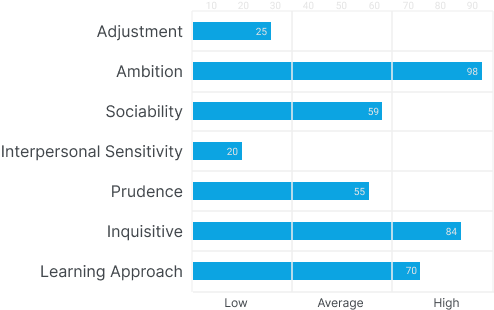
Yes. The HPI includes a built-in Validity Scale designed to detect rushed, careless, or overly managed responses. Falling below the required threshold, or leaving too many questions unanswered, will invalidate your results.
Retakes are subject to your employer's policies, so it's worth preparing thoroughly before your first attempt.
Use realistic practice to familiarize yourself with the test format. Our HPI PrepPack includes full-length simulations, study guides, and tailored tips to help you understand the traits assessed and align your responses with job requirements.
Customer reviews
4.9
★
★
★
★
★
Based on 86 reviews
yes
Yes
Fantastic self reflection
for wrong answrs you shopuld share correct answer with reason/justification
While the initial comparison of my test results to the "preferred" outcome for mgmt positions was adding nervosity, I have quickly realized that this test is not strategically selecting answers but about thinking who you really are and being ok with that. Some additional explanations before starting would be helpful to not fall into the trap to select the right answers to get to the desired corridor.
...
Why Trust JobTestPrep?
Founded by David Meshulam in 1992, JobTestPrep has over three decades of experience helping job seekers navigate competitive hiring assessments, including thousands of candidates preparing for Hogan personality assessments like the HPI. With over 220 preparation courses and millions of individuals supported worldwide, we offer professionally designed and regularly updated PrepPacks that reflect the latest test formats, as well as advanced AI-powered tools like our CV Analyzer and Interview Prep platform. Together, these resources help professionals across the US and beyond strengthen their applications, improve their performance, and achieve outstanding results.


More On Hogan Assessments
If you're preparing for a variety of Hogan assessments, you might find these other resources helpful:
- Hogan Bundle PrepPack (HPI, HDS, MVPI, HBRI)
- Hogan HBRI
- Hogan HDS
- Hogan MVPI
- Hogan Judgment Assessment
We've got everything you need to help you ace your Hogan tests!


